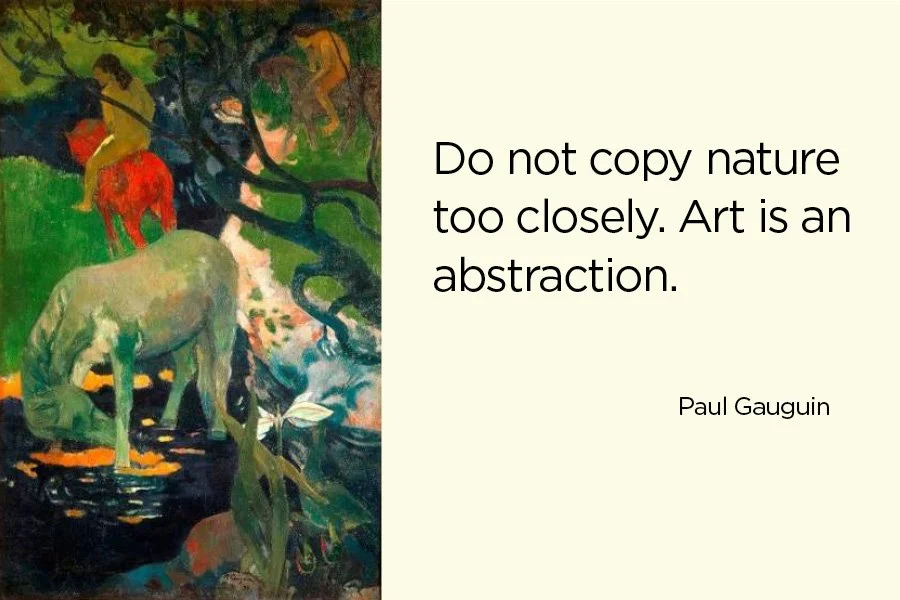
I recently finished Wild Thing: A Life of Paul Gauguin by Sue Prideaux, and I highly recommend it. Drawing from newly uncovered primary sources, including the resurfaced manuscript of Gauguin's most important writing and the previously untranslated memoirs of his son, Sue Prideaux challenges many long-held assumptions about the artist and his life.
What stayed with me wasn't just Gauguin's paintings, but the way each chapter of his life shaped his artistic voice. As artists, we don't create in isolation. Every experience, every place, every relationship leaves its mark on our work.
Gauguin was born in France in 1849, but at just eighteen months old moved with his mother and sister to Lima, Peru, where he was surrounded by a rich visual culture. As a young man, he traveled the world as a merchant marine before becoming a stockbroker. He was largely self-taught as a painter and spent years among the Impressionists before discovering his own distinctive voice. It wasn't until he immersed himself in the culture of Brittany that his work began to take on the symbolism and simplified forms we recognize today. Later, his travels to Panama and eventually Polynesia continued to transform his artistic vision.
One detail I especially enjoyed was how artists supported one another. They shared ideas, traded paintings, and encouraged each other's work. Theo Van Gogh, the art dealer and brother of Vincent Van Gogh, represented Gauguin's work, and Vincent admired his paintings enough to invite Gauguin to the south of France. Before Gauguin arrived, Vincent began what would become his famous sunflower series, ultimately completing fifteen paintings. They were created as a welcome and tribute to Gauguin, whose Peruvian heritage connected him to the ancient Incan sun symbol, the sunflower. Knowing that these iconic paintings were made specifically for another artist gives them an entirely new meaning.
Like many artists, Gauguin believed that changing his surroundings could change his work. He traveled to Tahiti hoping to find an untouched culture, only to discover that French colonialism had already transformed much of the island. He became an advocate for the Tahitian people while continuing to paint. After a brief return to Paris, he returned to Tahiti and later settled in the Marquesas Islands. Gauguin died there in 1903 at the age of fifty-three. For years, many believed he died from complications of syphilis, but modern DNA analysis of his teeth found no evidence of the disease, challenging another long-standing myth about his life.
Reading this biography reminded me that artistic growth is rarely a straight line. It comes from curiosity, travel, relationships, setbacks, and the willingness to keep searching. Gauguin's journey also reminds me that finding your creative voice takes time. Every season of life contributes something, even when we don't recognize it in the moment.